
Contact Us
Grand Prairie occupies a uniquely central position in the Dallas-Fort Worth Metroplex — stretching across both Dallas and Tarrant counties, it is one of the few DFW cities where a homeowner on one side of town technically lives in a different county from a neighbor a few miles away. That geography also means Grand Prairie’s housing stock tells a long story: the city’s older western sections near downtown and Forum Drive include homes built in the 1940s and 1950s, while its eastern corridors along Interstate 20 and Arkansas Lane filled in through the 1970s and 1980s, and newer residential development continues in the northern reaches near the Epic Waters area. Each development wave brought different construction standards, duct configurations, and equipment generations — all of which are now at different stages of the wear cycle that North Texas summers accelerate.
Ellis Air Conditioning and Heating has been serving the DFW area since 1975. Our technicians are familiar with the breadth of Grand Prairie’s housing inventory and the specific HVAC challenges that each era and neighborhood presents. We show up prepared to handle what we find rather than what we assume.
our services
- AC & Furnace Air Filter Replacement
- AC Capacitor Replacement
- AC Coil Cleaning
- AC Compressor Repair
- AC Installation & Replacement
- AC Maintenance
- AC Repair
- AC Tune Up
- Dehumidifier Installation & Repair
- Ductless Mini Split Repair
- Emergency HVAC Repair
- Freon Recharge
- Furnace Installation & Replacement
- Furnace Maintenance
- Furnace Repair
- Heat Pump Installation & Replacement
- Heat Pump Maintenance
- Heat Pump Repair
- HVAC Ductwork Repair
- HVAC Inspection
- HVAC Maintenance
- HVAC Repair
- Indoor Air Quality Solutions
- Whole Home Air Purifier Installation
Why Homeowners in Grand Prairie, TX Trust Us
AC Repair Services That Match Grand Prairie's Housing Diversity
Few DFW cities require a broader diagnostic range from their HVAC technicians than Grand Prairie. The same service route might include a 1950s cottage near the city’s western core, a 1980s brick ranch in the Dalworth Park area, and a newer two-story build near Lynn Creek Park — all with different equipment generations, duct configurations, and failure profiles. Our team is trained and equipped for all of it.
The repair services we provide to Grand Prairie homeowners include:
- Refrigerant leak detection and recharge to restore the cooling output that drops as aging systems develop slow charge loss through fittings, valve cores, and line sets that have been through decades of thermal cycling in the DFW heat.
- Capacitor and contactor replacement on outdoor units that have accumulated the electrical wear that comes from operating through many consecutive North Texas cooling seasons under sustained heat load.
- Blower motor and wheel service to recover the airflow that weakens in homes where aging motor components and long duct runs no longer deliver conditioned air effectively to every room in the floor plan.
- Evaporator and condenser coil cleaning and repair to address the efficiency loss that years of accumulated debris, pollen, and biological growth quietly produce on heat transfer surfaces in systems across all eras of Grand Prairie construction.
- Condensate drain clearing and biological treatment to prevent the backups and water damage that aging drain systems in Grand Prairie’s older housing stock become progressively more prone to as components accumulate years of use.
- Electrical and control board diagnostics to identify and correct the component damage that the spring storm and hail activity crossing Dallas and Tarrant counties each year leaves on exposed outdoor equipment.
We verify full system performance before leaving every Grand Prairie job — temperature differential, airflow, and operating pressures all confirmed before we consider the work finished.


How to Spot AC Trouble in Your Grand Prairie Home
Grand Prairie’s flat terrain and position between two major urban centers means the city absorbs summer heat from multiple directions with minimal geographic buffer. A system losing capacity here feels the effects faster than it would in a more sheltered location, which makes early recognition of warning signs particularly valuable for Grand Prairie homeowners. These are the indicators that point to a system that needs attention rather than time.
- The indoor temperature climbs above the thermostat setting during afternoon hours even though the system has been running without interruption since morning — a pattern that across Grand Prairie’s housing eras typically reflects a refrigerant, coil, or delivery issue rather than simply high outdoor conditions.
- Back rooms or bedrooms at the end of long duct runs stay several degrees warmer than the areas near the air handler, a common finding in Grand Prairie’s single-story ranch homes where original duct connections have loosened over decades of thermal movement.
- The system short-cycles — starting and stopping in rapid succession — which in Grand Prairie’s seasonal humidity reduces the system’s ability to manage indoor moisture and places repetitive mechanical stress on the compressor.
- A sound that was absent the previous season has appeared — a mechanical rattle from the outdoor cabinet, a grinding from the air handler, or a compressor that starts with noticeably more effort than before.
- Water staining appears near the indoor air handler or on a ceiling near a supply register, pointing to a condensate system that is no longer draining effectively.
- Monthly energy bills from June through September run higher than the same period in prior years without any clear explanation in thermostat behavior or home occupancy.
In Grand Prairie’s climate, these signals do not resolve on their own. Addressing them while the problem is still developing is consistently less expensive than waiting for a complete failure to force a call.
Why Grand Prairie Homes Face a Wide Range of AC Challenges
Grand Prairie’s dual-county position and its development timeline create an HVAC challenge profile that is unusually broad for a single city. The older western neighborhoods near downtown Grand Prairie include homes built before modern energy codes took effect, with original duct systems that have been through 60 or more years of North Texas temperature cycling. Joints and connections in these systems have opened significantly over that time, and conditioned air losses into attic spaces are common and often substantial. For homeowners in these neighborhoods, the duct system is frequently as important a maintenance concern as the equipment itself.
The city’s eastern corridors along Interstate 20 present a different but related challenge. Homes built along this corridor in the 1970s and 1980s sit adjacent to one of the busiest freight and logistics routes in Texas, where the concentration of industrial and commercial development generates a heat environment that keeps ambient temperatures near the corridor elevated above what open residential terrain would produce. Outdoor condenser units in these neighborhoods work against a higher baseline heat load, which accelerates electrical component wear in ways that compound across a long cooling season. Grand Prairie’s position in the cross-county spring storm path — where both Dallas and Tarrant county storm systems can track through the city — means hail and lightning exposure is a consistent seasonal factor for outdoor equipment throughout the area.

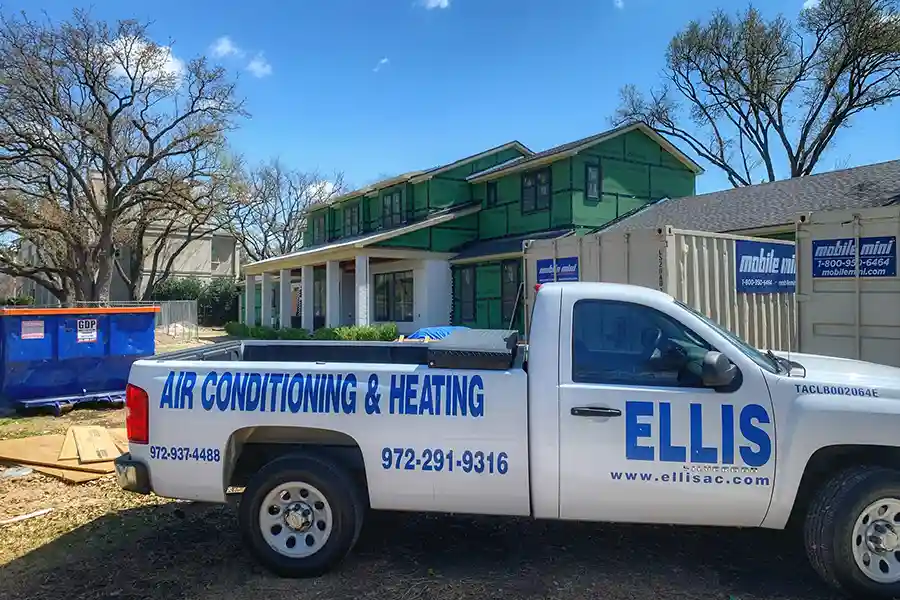
A Service Call in Grand Prairie's Lynn Creek Neighborhood
On a Tuesday morning in mid-August, we received a call from Nicole, a homeowner in the Lynn Creek area of northeastern Grand Prairie near Lake Joe Pool. Her two-story home had been cooling the downstairs normally but the upstairs had been climbing to 85 degrees by mid-afternoon for nearly two weeks despite the upstairs thermostat being set to 72. She had checked the upstairs filter — which was clean — and confirmed both outdoor units appeared to be running.
Our technician checked the upstairs outdoor condenser unit first and found the refrigerant pressure significantly below operating range. A leak search identified a small breach at a service valve fitting that had developed over time, consistent with the vibration wear that fittings on older outdoor units accumulate through years of compressor operation. The fitting was repaired and the system was recharged to the manufacturer’s specification. A full performance check confirmed the temperature differential and operating pressures on the upstairs zone had returned to normal range within a single cooling cycle.
Nicole mentioned the upstairs had seemed progressively harder to cool over the past few months but she had attributed it to the summer heat load on the upper floor. The technician explained that while upper floors do run warmer in a two-story home, the gap she had been experiencing was well beyond normal — and that the gradual nature of the refrigerant loss was exactly why it had gone unrecognized until peak August demand made it impossible to ignore. An annual spring pressure check on both zones would have caught the developing leak months before it became a mid-summer breakdown.
Why Grand Prairie Homeowners Choose Ellis Air Conditioning and Heating
Grand Prairie is a large, diverse city and its homeowners have a wide range of service options to choose from. What they cannot easily find elsewhere is the combination of verified credentials, regional experience, and a commitment to honest service that Ellis Air Conditioning and Heating has been delivering to DFW homeowners since 1975. Every Grand Prairie customer who calls us gets the full benefit of what more than five decades of doing this work the right way looks like in practice.
What Grand Prairie homeowners can expect from Ellis:
- Over 50 years of uninterrupted DFW-area service, with firsthand experience working across Grand Prairie’s full range of housing eras and the specific HVAC challenges each generation of construction presents.
- A service team averaging more than 10 years of tenure with Ellis, delivering consistent expertise and accountability from professionals who have seen virtually every failure mode this climate can produce.
- Active, verifiable credentials: Carrier Factory Authorized Dealer, NATE certification, BBB A+ Rating, and Texas TDLR license TACLB002064.
- Fully stocked service trucks prepared for the most common DFW repair scenarios, enabling us to complete most jobs in a single visit without leaving a household without cooling while waiting on parts.
- 24/7 emergency availability because a failed AC system in a Grand Prairie home on a summer afternoon is an urgent situation that cannot wait until the next business day.
- Free estimates and upfront pricing before any work begins — no surprises and no pressure at any point in the process.
We are a family-owned company, and every service call in Grand Prairie is an opportunity to demonstrate the integrity and reliability that have defined how we operate since 1975.